When young Budapesters know more about air pollution, they don't always plan their day around it
Most young people in Budapest are concerned about air pollution. Most have heard of the Air Quality Index (AQI). Almost none of them actually plan their day around either. That awareness to behaviour gap, and the wellbeing trade-off hiding behind it, sits at the heart of a new mixed methods study run with eight interviewees and a questionnaire of 27 respondents, all aged 18 to 24.
Concerned, but not planning
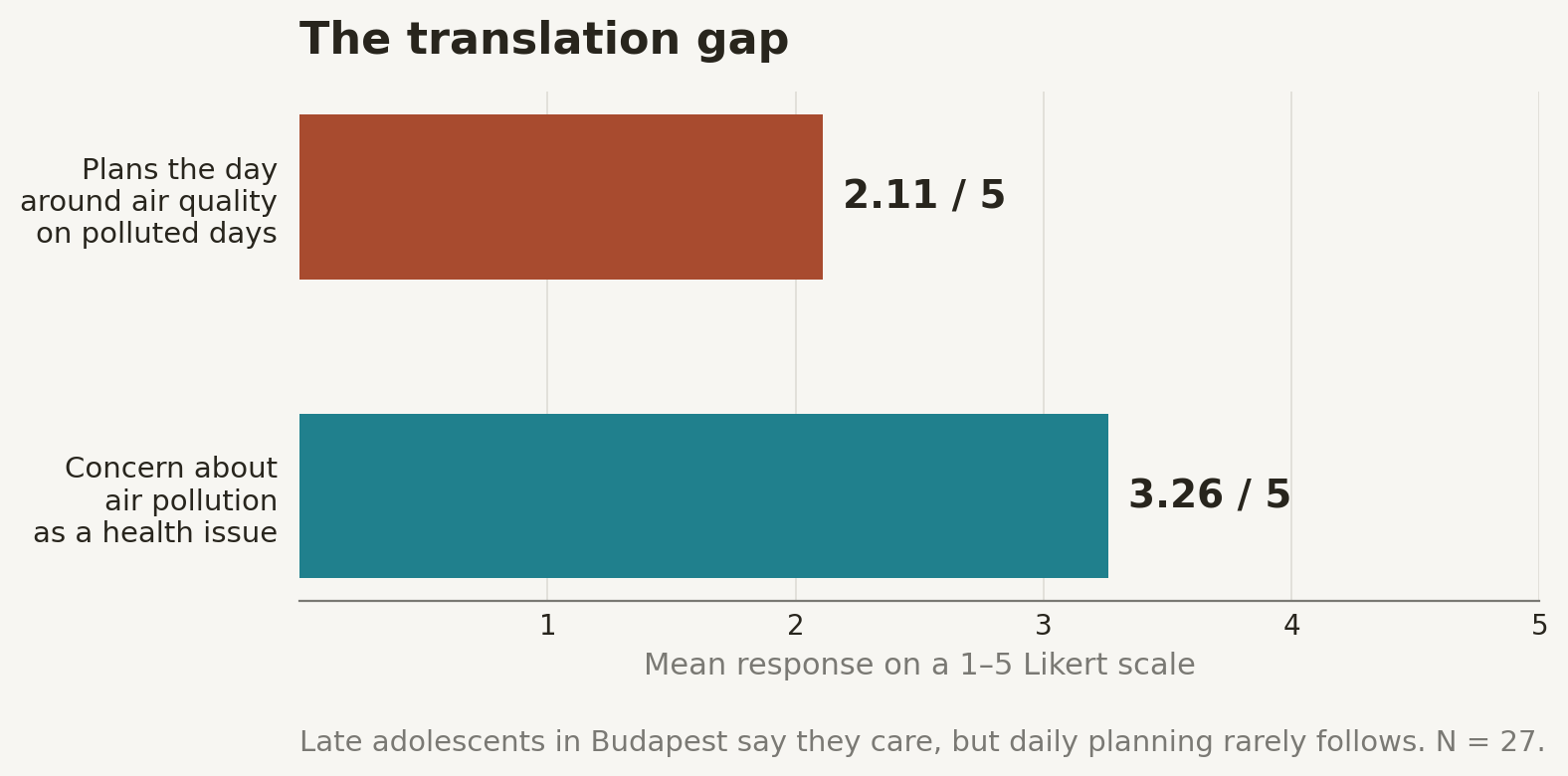
Concern about air pollution as a health issue averages 3.26 on a 1–5 scale. When the same young people are asked whether they take air quality into account when planning their day on polluted days, the average drops to 2.11. Roughly half of the sample knows what the AQI measures, and nearly a quarter has never heard of it.
This is the translation gap the report names: caring about the issue and recognising the language of air quality measurements does not, on its own, change what young people do on a usual morning.
Knowing the index is not what tips someone into action
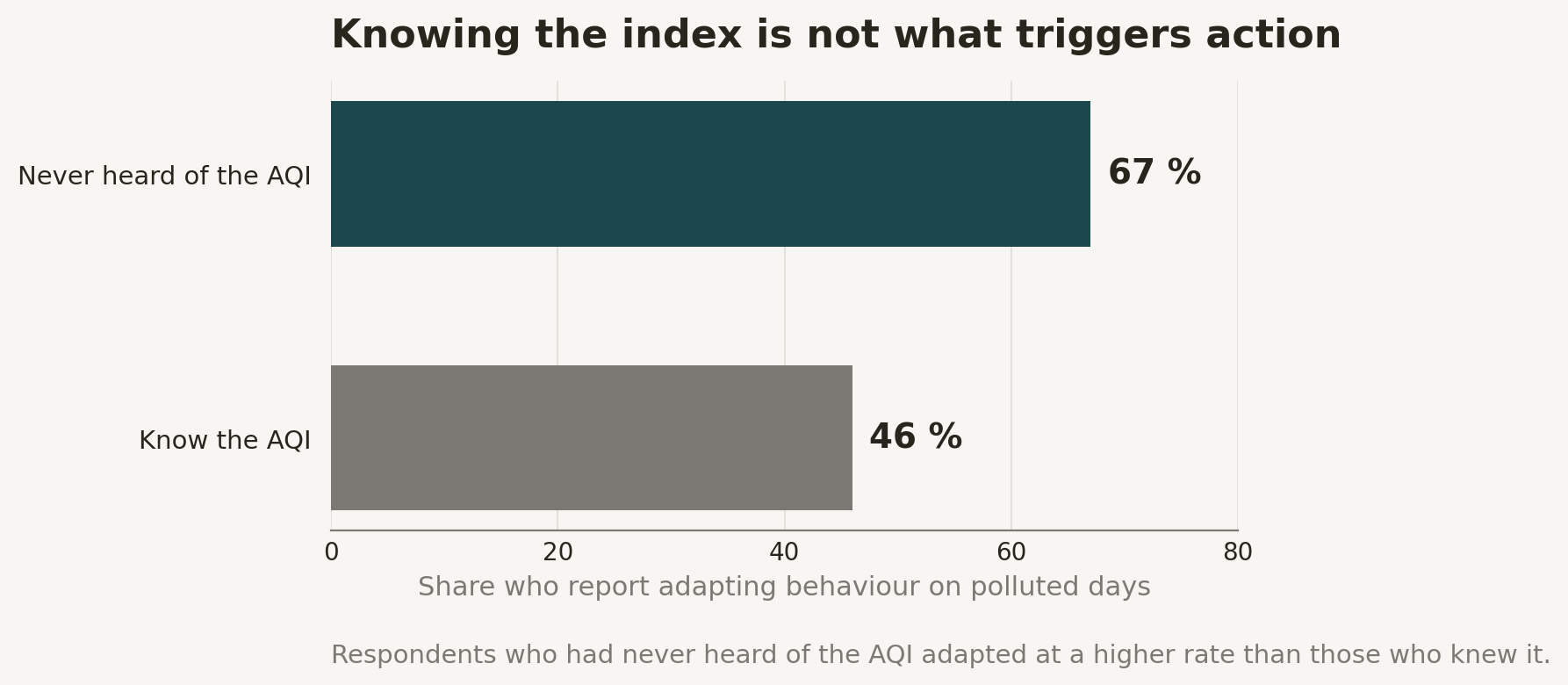
One of the more uncomfortable findings: respondents who had never heard of the AQI reported adapting their behaviour on polluted days more often than respondents who knew the index. Sixty-seven per cent of the non-aware group reported at least one active adjustment, against forty-six per cent of those who said they knew what the AQI measures.
AQI literacy, in isolation, is not what flips the switch. What does flip it, across the eight interviews, is a concrete personal lever: a medical history (one interviewee has asthma and uses a dedicated app daily), a consequential outdoor activity (a competitive runner who plans sessions around pollution windows), a designed environmental cue (a smiley-face air quality sign in a city park that changes colour with local readings), or a digital tool that converts AQI into graded, activity specific advice rather than a raw number.
Imported from somewhere else
In six of the eight interviews, the working baseline for what counts as bad air came from somewhere other than Budapest. Interviewees benchmarked the city against Alaska, the French countryside, Paris, Lyon, Bayonne, or simply a home country. Those embodied comparisons (breathing easier on the coast, getting headaches arriving in a denser city) did more practical work than any index. Comparable risk perception research, including a systematic review of particulate matter risk perception and a Mexican megalopolis study published in Atmosphere, finds the same pattern: people anchor risk in experience, not in concentration data.
Young people also do not separate air from the rest of the urban package. They describe bad air in the same breath as noise, trapped heat between buildings, and exhaust smell. For an air quality only message, that is a real problem, the lived category being targeted is wider than the campaign assumes.
“I could, but I don't.”
When awareness becomes a burden
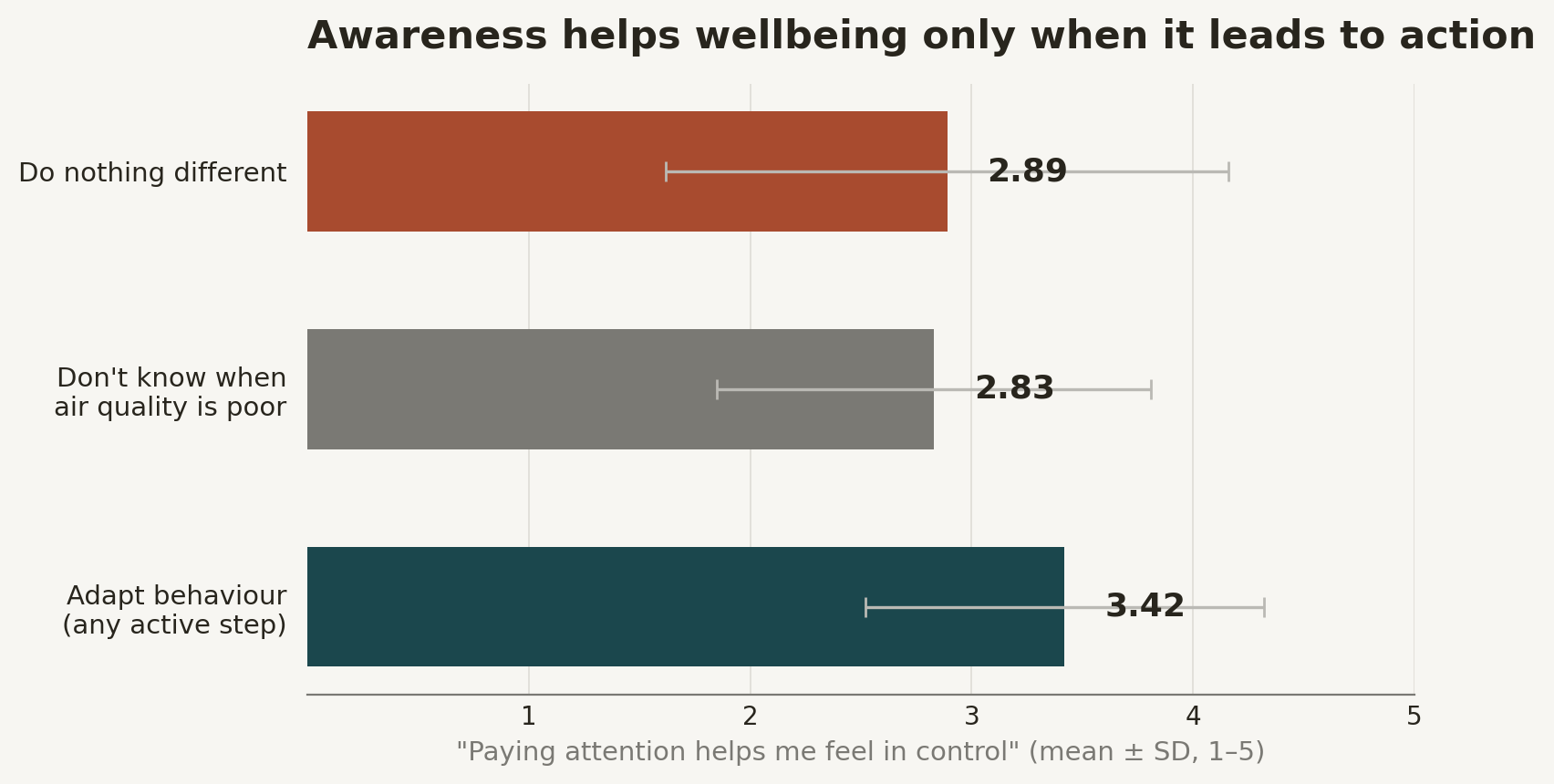
The main report’s companion article on awareness as a burden surfaces a second pattern. For some participants, knowing more about air pollution adds stress without giving them new agency. Responses to "knowing about poor air quality makes me feel more anxious or stressed" sit almost exactly at the midpoint of the scale. The companion item, "paying attention helps me feel in control", leans only slightly positive overall, and that small benefit is concentrated entirely in the subgroup that actually adapts.
Among the twelve respondents who report any active adaptation, the control score averages 3.42 out of 5. Among the six who say they do not know when air quality is poor, it drops to 2.83. Among the nine who say they do nothing different, it sits at 2.89 with a notably widespread.
One interviewee described a "spiral of information and knowledge" after clicking a single air-quality notification. Her phone began pushing more pollution and environmental content, increasing anxiety without changing her routines. That pattern fits a growing strand of research on environmental message fatigue and on the way social platforms can amplify climate related anxiety, as flagged in recent communications work on climate and health risk.
The wellbeing trade-off nobody is naming
When young people in this sample do change behaviour because of air quality, they almost never withdraw entirely. They substitute (a run becomes a gym session), they shift timing or route, or they apply windowed mitigation (closing the windows for a few hours). Even those partial moves come at a cost, because outdoor exercise, green spaces, and outdoor socialising are rated as essential or very important to emotional functioning by most respondents.
Fifty-two per cent reported feeling somewhat or much worse on days when outdoor activities had to be reduced or avoided for any reason. The evidence linking green-space access to adolescent mental wellbeing makes this less surprising than it might first sound. The activities young people are asked to give up on polluted days are precisely the ones that anchor mood the rest of the time.
So what should an air quality organisation do with this?
Four working implications come straight out of the data.
First, awareness messaging aimed at this age group cannot stop at concern or at nominal AQI literacy: both are widespread already and neither translates into daily behaviour on its own. Pair every air quality measurement with a concrete, graded behavioural recommendation in the same message, in the manner of the app one interviewee relied on, rather than presenting the index as a free-standing number.
Second, the strongest non-digital cue documented in this study was a smiley-face air quality sign in a public park, a passive signal that prompted action without requiring active checking. Investment in similar public realm signage near schools, parks, and transit nodes is a candidate intervention that air quality NGOs are well placed to advocate for, given their potential relationships with municipal and civic stakeholders.
Third, the wellbeing trade-off needs to be acknowledged in campaign language rather than glossed over. Telling young people to stay inside on polluted days without addressing the loss of the very activities that anchor their mental health produces either non-compliance or compliance with a hidden cost. Substitution framings (greener routes, alternative outdoor settings, modal shift commuting) are more likely to align with what young adults in this sample actually do.
Fourth, because awareness without agency can itself become a source of stress in this group, every awareness intervention should be paired with an actionable component, however small. An address to write to, a route to switch to, a window to close, a graded recommendation to follow. Awareness alone is not a neutral good for this population. It becomes one only when it is coupled to something a young adult can do with it.
Read the full work
The blog summarises a research project conducted at Clean Air Action Group between February and May 2026. The full concise research report, plus the two long-form analytic articles that informed this post, are linked below.
• Article 1: Where Useful Air Quality Awareness Actually Comes From (deep dive on imported awareness, designed cues, bundled urban stressors) [Download]
• Article 2: When Air Quality Awareness Becomes a Burden (anxiety without agency, cognitive dissonance, algorithmic spirals, wellbeing trade-offs) [Download]
Research conducted by Filip Kopta during a bachelor internship at Clean Air Action Group (Levegő Munkacsoport), in partnership with Windesheim Honours College.
Mentor: András Lukács.